Tuesday, April 7, 2009

The Land of Bavarian Cuisine, Polka Dancing, and Beer

By Casey Elliott

Countless travelers enter Munich concerned; Have they reached another Americanized tourist destination? Behind the McDonalds, Burger Kings, and Starbucks, you can uncover one of Europe’s most festive cities and some of the world’s darkest history. A few days in Munich experiencing its activities and attractions can keep you and your stomach satisfied. Fill your itinerary with savoring Germany’s comfort foods, dancing the polka with locals, shopping inside the city walls, and pondering Germany’s dark Nazi history at the Dachau concentration camp.

While German is the language of Munich, English is widely spoken and getting around is simple even speaking little or no German. Take advantage of taxi rides and soak up as much conversation and culture as you can from your driver. Sometimes you find they are a wealth of knowledge that can help you along in your travels. If you want to immerse yourself in this Bavarian culture, walking the city walls would be your best choice. Easy access to all of Munich’s well known destinations can be done by walking, taxis, or streetcars.

Travelers do not need to venture far from the main train station to find authentic German cuisine and beer halls. Augustiner, famous for the Radler, a mix of beer and lemonade, is located within a five minute walk from the train station. The sweet mix is a perfect way to wash down your meal. Their menu is capable of filling any Bavarian craving with dishes such as Wiener Schnitzel, fried and grilled sausage with sauerkraut, and Viennese sausage. If you do not want to leave the restaurant with an uneasy stomach, do not attempt the sausage salad, a plate of shredded slimy hot dogs with onions drenched in vinegar. Don’t ruin your first German meal by ordering this in hopes that you will actually get American sausage on top of a bed of lettuce.

Fruit filled cakes and torts with complete their menu, hold off. Satisfy your sweet tooth in a local bakery. What may seem like an American breakfast is a common dessert for Germans. Treat yourself to a cup of coffee and a German doughnut after your Bavarian meal. The doughnuts (which have no hole) are usually deep-fried balls of yeast dough with jam or other fillings and powdered sugar sprinkled on top. Relax in the bakery soaking up its sugary aroma and sip on a cup of Germany’s strong dark coffee.

Leave your calorie consumption guilt behind and walk the main center strip that winds through the city’s most beautiful scenery. One side of Munich’s downtown roads is l
ined with stores to satisfy every traveler’s needs and wants. High-fashion shops to small boutiques, the mile-long shopping zone is graced by the sugary aroma of caramelized nuts roasting. The strip encompasses Munich’s vibrant city walls and architecture that is seen for miles.

For a chance to savor a German beer, spend a night clanking oversized mugs filled with some of Germany’s best known beer at the Hofbräuhaus, a beer hall in the city center of Munich. For 20 Euros you can indulge in a buffet of German cuisine and beer. The buffet is all inclusive food and festive entertainment for the night. Travelers must commit to a possible hangover and bulging stomachs before attempting this buffet. A bucket of pretzels awaits your arrival at the table preparing your stomach for the long line ahead. Fill your plates with a variety of German meat including Weiner schnitzel or skip to the end of the line and embrace a homemade apple strudel with custard sauce and red fruit jelly drizzled on top. While feasting on German cuisine, embrace the warm atmosphere and mix with locals and tourists all there for the same reason. Polka dancers, medieval performances and bell ringers assure few dull moments. When your stomach convinces you one more bite may have serious repercussions, head downstairs to the main beer hall.

Midway through the hall is a table under a sign that reads “Stamm 100 Dilch”. You may receive an unwelcoming glare from a group of men who look angry and tipsy but it is worth it. The table bears a myth that all who sit under the sign and drink a beer will live for a 100 years. If you manage to fit another beer into your full stomach, you might as well go all out and try a frosted gingerbread cookie that you can buy from waitresses dressed in polka outfits carrying baskets, but do not be mistaken. At first glance these treats resemble an American cookie cake, there is a distinct difference in taste between the Germans ginger spiced cookie and Americans sugar spiced cookie.

As much as Germans like to celebrate their proud heritage with beer, polka music and sweet desserts, Munich offers visitors a sobering look at its darker history, the nearby concentration camp of Dachau. The camp is about 15 minutes by train outside of Munich. Good weather and a tour guide can make or break this experience. Warmer weather temperatures are a must for this site due to long walking hours in the cold. Guided tours are offered for around 15 Euros and can provide direction, information, and little facts that bring the camp to life. As you enter Dachau a sign in German that greeted prisoners who walked to their death in the 1930s still adorns the front gate: “Work will set you free”. The tour takes you down the path new arrivals to the camp would encounter including the gas chambers disguised as showers where they died. Walk through the barracks to see the sleeping conditions the prisoners experienced on the undersized and overcrowded wooden cots. Finish this somber experience at the crematorium that displays the process of burning the prisoners’ bodies. The end of the tour is marked by a memorial sign that reads “Never again,” in several different languages.

Whether tourists are celebrating Munich's music, food, beer and cultural heritage in its raucous beer halls or learning about its darker history at a somber Dachau, this Bavarian capital is worth your time.

Casey Elliott, a University of Kansas journaslism student, studied in the CIMBA undergraduate program in spring, 2009.

A Day Under the Tuscan Rain

By Megan Sayler

We stepped off the train in Cortona hoping to see the villas and mountain vistas of Under the Tuscan Sun, but instead saw misting rain from an overcast sky and not a single person in sight. As we stared up from the base of a mountain, my friend Megan and I realized that Cortona was at the top, five miles up, and we were in Cambucia, at the bottom. The town seemed vacant with no buses or taxis running on this Sunday morning. Never did we imagine that a courtesy ride up to the top from a sympathetic Italian would lead us to a meal we would never forget or that we would return to this same train station in just four hours with full stomachs and warm feelings for Cortona.

Wandering to the only open store, we peered inside to find Italian men staring at us, wondering why two American college women were wandering Cambucia in the rain on a chilly Sunday. We motioned a steering wheel to them to indicate “car” and said, “Cortona?” but no one responded. After many attempts at communication, one man offered to drive us up to Cortona in his small red, beat-up car. The ride up to Cortona’s Piazza Garibaldi was in silence, but the drive became increasingly scenic nearing the top; the winding, narrow roads offered views of zigzagging rows of olive groves and smaller farmland villages with orange and white rooftops. We offered to pay our driver, but he motioned that he wanted our phone number, not cash. After reluctantly trading numbers, we began our journey at Piazza Garibaldi, the front entrance of Cortona.

We had no plan to experience this hilly Tuscan city, so we walked up and down through the vertical medieval walled alleys and squares, deserted on this rainy day. Different colored window shutters and doors personalized each home, and even though it wasn’t sunny, the blues and greens of the shutters shone brightly. With each uneven street we began to hike, we talked about how difficult it must be for older Italians.

Feeling the cold, we wanted to escape the rain, so we went to the closest restaurant, Ristorante La Bucaccia, right off the central Piazza della Repubblica on Via Ghibelllina. The restaurant had just opened for the day at noon as a rosy cheeked, short Italian man with a protruding belly came out from the kitchen to seat us. As he showed us the way, I pulled the Rick Steves book out to mention that he was listed in the “Eating” section. He grabbed the book from my hand and in disbelief kept turning from the page he was featured on to the front cover as he asked, “Is this this year? 2009? I am in this?” His excitement made us laugh and he called for his wife and 11-year-old daughter, who was a miniature version of the mother. “My name is Romano, this is my wife who makes all the food, Agostina, and this is my daughter Francesca. Let’s take our picture!” As he called out an additional helper from the back, he posed us for pictures in three different locations, including his wine cellar he is very proud of (“It holds over 400 bottles of wine,” he said).
Finally, he sat us down and took our menus off the table. He exclaimed, “I will give you what is the best. The specialties! Just sit and wait.” The tables were only a foot apart from the other in a darkly lit cobbled stoned room. Overtaking the table in the corner were two 3-feet-long legs of pork; our antipasto came from meat scraped with a fork on the inside of the legs and was topped with a potato, fig, and honey jelly.

Following were two pastas: a doughy, fresh homemade pasta doused with a pecorino-cheese sauce, followed by chestnut flour ravioli filled with ricotta topped with tender porcini mushrooms. Each slightly tender, al dente bite of pasta made my eyes close and my throat “Mmmmm” in satisfaction. Next, Romano brought out what he called Chianina beef, which with the touch of the knife fell into juicy pieces, and roasted potatoes topped with rosemary. We had come up to the hill to Heaven: Romano was giving us the best meal of our stay in Europe and topped each course off with another glass of his favorite red wines. We expressed our euphoric approval of his food every time he passed. He would give us a wide smile, pinch our stuffed cheeks, and say, “Aw you like it, good!”

As the after-dinner espresso and chocolate chip biscotti were being served, we stepped back into reality and prepared ourselves for a bill that was over our student budgets. Approaching the counter, Romano said, “You pay…” and he scribbled 30 euro, which we looked at with astonishment. Then he interrupted our gratefulness and said, “No 20 euro total actually, and when you are cooking with your family back home, email me and you can impress them with my recipes.” We exchanged emails, he hugged and kissed us on both cheeks, and we walked outside into the cool rain.

The taxi, called by Romano, drove us down to the train station where our day had began on such a bleak note. Our state of mind was in a completely different place than when we arrived. I learned that Cortona does not need the Tuscan sun to be enjoyed. On this rainy day, we enjoyed the city’s architecture and scenery, and in our escape from the cold rain, found hospitality and food that kept us warm for the rest of the day.


Megan Sayler, a University of Kansas journalism student from Kansas City, studied in the CIMBA undergraduate program in spring, 2009.

Rupert

By Meaghan J. Hinder

“Don’t look so worried miss,” the Australian man in his 70’s said as he searched through my backpack. He carefully took out every item I had jam-packed into my carry-on. A long line of people behind me waited, anticipating the same embarrassment. I’ve been using this particular bag since my first day of college roughly two and a half years ago. Ask me how many times I’ve emptied it.

I guess it was written all over my face, I was worried. How could I not be? I don’t even know what’s in there. Apparently at some point I purchased crayons; He pulled the remnants of a 12 pack out of a compartments I didn’t know existed. “Oh, yep, that’s just a mini travel deodorant that must have melted,” I said. He smirked. I could tell he secretly loved his job at that moment.

He had a kind face and a scruffy beard that looked like salt and pepper was sprinkled on his skin. The shiny plastic nametag gave Rupert the power to embarrass any person he felt like. First me, then another young girl: “Uhh yes, you there, come along. Come around here I thought I saw a liquid in that purse on the screen there.” So he searches through her bag and takes out condoms and birth control pills. She sweats as her parents peer over her shoulder. Turns out there’s no liquid in her bag. This man on his airport-employee high horse humiliates innocent people day after day.

Suddenly, I spotted the purple corner of a small cardboard box Rupert is taking out my bag. Before I could plead with him, my glow-in-the-dark panda puzzle was revealed for every eye to see. I didn’t say anything, just remained still and wondered, on a scale of one to ten, how weird these people think I am? Meaghan, I thought to myself, why would, as an intelligent 20-year-old college student, you bring an ages four and up activity halfway around the world? Before I had time to answer myself, Rupert declared, “Well that’s something I didn’t expect to see miss.” “Well Rupert,” I said “there’s a whole lot more where that came from, I’m sure.” I was right.

With that he removed a leather-bound journal, a neck-rest, highlighters, broken hair-clips, an expired gift-card to a porn shop (gag gift from my 18th birthday), a Virginia Tech cap, Tylenol PM, an extra pair of socks, and, last but not least, an extra pair of grannie panties, in case my luggage was lost. “Happy?” I asked. “Dumbfounded,” he replied.


First time seeing the Alps from the plane!

Rupert then re-packed my entire bag. Surprise, surprise, there was nothing dangerous or forbidden there for him to remove. What a conspiracy.

I walked away with blazing red cheeks but also, a newfound confidence. Who I am includes glow-in-the-dark puzzles and grannie panties, so be it.

Meaghan Hinder, a Virginia Tech student of communication, studied in the CIMBA undergraduate program in spring, 2009.

A dark story to tell

By Niki Thiessen

A wet mix of steady snow and rain and the gray low hanging clouds seemed right to visit Dachau, Nazi Germany’s first concentration camp, outside of Munich. The atrocities at Dachau stand as a reminder of how humanity can be swept up by charisma. While I expected to experience emotion, I never expected to learn lessons from a homeless drunk, the sound of gravel, and a cold howling wind.

Tour guides provide the best way to experience Dachau (for a tour guide see side bar). Dachau, the first and model camp for all concentration camps that followed, lies about 15 kilometers outside of Munich. It opened three months after Adolph Hitler became Germany’s Chancellor, as a work camp for his political adversaries.
As we waited for the bus to Dachau, our tour guide outlined what we would be seeing. While he was speaking a young man, wearing ragged clothing and no coat started harassing the tour guide. With extreme patience the guide stood there while the drunk rambled incoherently, breathing putrid breath down the guide’s neck. German police walked by without a sideways glance. Through the illogical mumbles we realized the man was trying to be arrested so he could have someplace warm to stay for the night. As I waited to visit Dachau, where 60 years ago people risked their lives to avoid imprisonment, this man wanted to go to jail.

When we arrived at the only concentration camp to operate for the entire 12 year span of the Third Reich, the somberness of the site enveloped me in a cloud of contemplation. “Arbeit Mact Frei” which means freedom through work, greeted me just as it did thousands of prisoners who entered Dachau’s imposing gates. The entire camp was set up as a mind game for the prisoners. “Smoking forbidden” was written on the walls, but prisoners didn’t have cigarettes. Prisoners were assigned bunk houses in a hierarchical fashion. German prisoners were always treated the best and Jewish prisoners had the least chance of survival. Bunk houses were bare and everything was and still is gray.

Even the gravel beneath my feet was a slate color. The scratching and crunching of my shoes made my imagination run wild. I asked our tour guide if the gravel had always been there. It had. Sixty years ago a young man or woman my age walked across this place, heard the same crunch and shuffle of stones underfoot, but that person had not voluntarily chosen to come to this place. Men like Edgar Kupfer, taken prisoner for being part of a vegetarian organization and mentioned multiple times on the tour, stood on the same gravel every morning for roll call. They stood there as a punishment for looking up, for missing a speck of dirt in the dormitories, or just because an SS guard felt the urge to punish someone.

A six-foot wide strip of grass surrounds the perimeter of the camp. It haunted me knowing that hundreds of prisoners were shot dead on the spot when they stepped onto the sweet, soft grass. Some were shot in the legs and taken to the infirmary where they were used as experiments by Dr. Rascher, the camp physician.

Standing in the middle of the desolate gravel lot I shivered. The cold air stung my nose and cheeks. Tears flooded my eyes, not from the cold, but from the embarrassment that I wanted to complain about the cold when I was so warmly dressed. Back then men and women would have to stand for up to 72 hours in the same weather with only a blue and white striped cotton shirt and pants suit.

As if on cue the wind howled and I imagined the cries of the thousands who suffered and died. They wailed for future generations that may never understand the atrocities of Nazi concentration camps. They lamented for the generations of unborn lost at Dachau. And they pleaded for education so that something like Dachau may never happen again.

No one knows how many people were killed there. Estimates range around 40,000 people, but these numbers do not include the hundreds that were sent to Dachau for “special treatment” or extermination on arrival. The SS did not keep records of those prisoners. The camp was liberated on April 29, 1945 by the U.S. army. Edgar Kupfer had survived along with more than 8,000 pages of a diary he secretly kept amongst Nazi files. His diary which is now housed at the University of Chicago Library provided useful insight to life at Dachau.

As I left Dachau that day I took with me the memory of a homeless man wanting to be jailed. With a warm bed and hot meal, he would have it so lucky compared to this place. I took the sound of gravel crunching under my feet. And I took the sound of voices past. From now on the sound of crunching gravel under my feet will remind me of those who cried at Dachau, begging me to tell their story.

Dachau Tours
The Dachau Concentration Camp Memorial Site Tours meet Tuesday to Sunday at 10:10 a.m. in front of the main entrance to the Hauptbahnhof (The main train station). Reservations are not necessary, but large groups should call in advance. The cost is 19 euro for adults, 15 euro for students and free for children under 14 when they are accompanied by an adult. All prices include transportation costs. All tours are in English and explore the rise of Nazism in Germany, the concentration camp system, prisoner life, death and survival, and usage of the site after 1945. For more information visit the website at http://www.dachautour.com/ or call +49 (089) 66064746.


Niki Thiessen, a journalism and communications double major at the University of Kansas, attended CIMBA during the spring of 2009.

Cinque Terre: Nature's Canvas

By Clair Wenzel

Miles of narrow dirt trails wind along the coast past the olive and lemon trees. As you make your way past, the air is thick with the smell of lush vegetation and lingering ocean spray. Countless steps carved into the earth lead you up and up into the vineyards. Suddenly, through a break in the trees, you peer down on the town you left not long ago. With this perspective emerges a new respect for the beauty of Vernazza. The houses appear like a crayon box of pastels, stacked one on top of the other, seeming to lean on each other for support. The tiny turquoise harbor is guarded by a line of muscular boulders, jutting out into the sea. They hold fast as surging waves crash up in a vain attempt to break through. This is European nature at its best offering tourists villages, oceans, sky and mountains rather than cities monuments and duomos. The Cinque Terre is a refreshing change of scenery from the maze of museums. Here, your time is spent outdoors, working your way down the coast and breathing in the natural beauty of the Northwest coast of Italy.

When my parents decided to visit me in Italy, I saw Cinque Terre as an ideal window to share a relaxing weekend with them.

The Cinque Terre are a group of five villages connected by a system of hiking trails that hug the coast while weaving in and out of lush foliage. The laidback attitude of the locals, the beauty of the landscape and just a pinch of pesto made sure that Cinque Terre did not disappoint.

The five towns are all connected, but it is important to select one as a home base to sleep, eat, and plan your hikes. Each of the five towns encompasses a distinct personality. Monterosso features a large beach the stretches across the village. Vernazza is the most touristy of the towns, yet is perhaps the most beautiful. Corniglia has the highest elevation and breathtaking ocean views. Manarola feels like a fishing town and has lots of opportunities to explore. And finally, Riomaggiore is the least touristy and most in tune with local customs. We settled on Vernazza as our base town. Its central location and easily accessible dramatic hilltop sights sealed the deal. The charming village is centered around one main road that runs from the train station to the harbor. Because of this, it is the easiest to navigate. From the train station we descended the stairs, continued walking along the main road and within minutes, we saw the harbor.

Our arrival happened to fall within the off-season. While many may argue it is essential to visit Cinque Terre a little later in the year when it is warmer, the lack of crowds had its advantages, including a wide selection of places to stay. In addition, we gained the ability to investigate several places and even barter for our desired price. Extra leverage may be gained by booking more than one night at a time, or if you are traveling with a large group. Many locals profit by renting apartments or rooms to tourists. They are a great value and provide all the essentials. We settled on renting from Rosa, whom we had read about in a Rick Steves travel book and her price fit the bill. We paid 75 euros a night for the three of us. Her apartment was perched three stories above the main road, midway between the train station and the harbor. The antique door was dusted with a hint of wintergreen, which stood in stark contrast to the vibrant peach hue of the building. Examining the panel beside the door, I pushed the button that read “Rosa’s rooms.”

Before I could remove my finger from the buzzer, a petite elderly woman opened her purple shutters several stories above us. “Buon Giorno!” she said looking down at us. A native Vernazza resident, Rosa is petite in stature and as delicate as the antique lace shawl she had draped across her shoulders. After hearing of our interest in a room, she wasted no time, making her way down to the front door to escort us to our apartment. We followed Rosa up 62 steps, which slowed me down as I toted my overstuffed travel backpack. Rosa took each step with great care so as to not misstep and bowl my parents and me over back down to the street. At the top, we entered the modest apartment. It had a bathroom with a small water heater, small kitchen with minimal appliances, a double bed with a pull out couch in the next room where I would sleep, and a quaint bedroom adorned in lace with a double bed for my parents. The best feature of the apartment was the spacious outdoor patio located off the bedroom with a table and three chairs that looked out at freshly laundered undergarments hanging from the line directly next to our balcony. We could peer past the shutters across the alley and witness a woman hard at work preparing a meal in her kitchen. Living in an apartment, at eye level with the residents of Vernazza, provided an opportunity to blend in.

The main event while visiting Cinque Terre is experiencing all five towns through the hike along the coast. The Cinque Terre paths were recently established as a national park. This is to ensure the trails are maintained and protected from environmental harm. However, because of this, hikers must pay fees to hike the trails. A one-day pass costs five euros, and a two-day pass eight. With the Cinque Terre Pass, you get a map as well as unlimited use of shuttle buses to and from each town. You may purchase the card at train stations or the national park offices. Keep in mind, you shouldn’t need more than two days to hike Cinque Terre. Typically the hike between all cinque towns takes about four to five hours. The trails are clearly marked with red and white stripes, which guide hikers through winding alleyways in the towns as well as lead you to some of the best photo opportunities in all of Italy along the coasts.

The trails are by no means difficult. They range from the slightly challenging dirt covered, stair-filled trail between Vernazza and Monterosso, to the senior citizen’s choice, the sidewalk-stroll down Via dell’ Amore between Riomaggiore and Manarola. However, appropriate shoes are essential, such as basic pair of tennis shoes. I would also suggest layering your clothing. The crisp morning air feels frigid at first, but after the third set of endless stairs, extra layers will find themselves tucked away into a travel backpack. The trails are very easy to navigate and a map is not necessary. Along the way you will encounter a handful of informational booths owned by the national park that serve as valuable resources for tips and advise for your best hiking experience.

The hike from Vernazza to Monterosso proved the most challenging. However, it was also the most rewarding. As you follow the paths that were originally intended to allow access to the hillside vineyards and olive groves, you gain a new respect for the workers who labored to construct the walkways. The ocean views demand your attention. It’s difficult to maintain a constant pace, as you constantly find yourself stopping and grabbing your camera to capture the image, in hopes you will be able to remember it forever. Strategically placed picnic benches invite hikers to rest their feet while taking in the spectacular ocean views.

Emerging from the trails, we found ourselves in the beach town of Monterosso. The town was seemingly closed for the winter. However, after a short walk we encountered a group of locals. Scattered about in the street, a group of five slender Italian boys were passing an under inflated soccer ball back and forth. Their fathers were standing watch with a cold beer in hand. Before my mom and I had a say, my father was making his way to the source of the beer and the apparent neighborhood hangout. Ironically named, The American Bar is the place where locals choose to grab lunch in Monterosso. With walls plastered with American movie posters and Aerosmith playing from the stereo in the corner, we had to commend the owners for their tastes. The sandwiches we ordered were made with fresh foccacia bread, mozzarella cheese, tomato, and of course, fresh pesto. After being grilled to melted perfection, the sandwiches (four euro each) really hit the spot. We were ready to continue our hike to the other three towns.

Cinque Terre is an escape from urban Italy. No need for museums or monuments. The Cinque Terre is a piece of art in itself, with its dramatic hilltop views and quaint villages always on display for those fortunate enough to see them.


Clair Wenzel, a University of Kansas journalism student from Minneapolis, studied in the CIMBA undergraduate program in spring, 2009.


Old Town Square


By Megan Turner

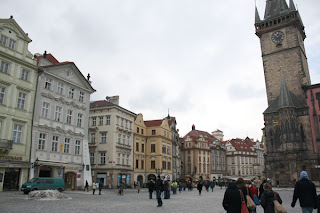
On a chilly day in February, light snow creates a magical scene in Old Town Square, the center of Prague since the Middle Ages when it served as a crossroads market for European merchants and vendors. Through the years, it has been the object of many invasions and rebellions. Each new ruler left evidence of a lasting impression, which tourists, like me, are there to see. The charming architecture and imperfect details of the square hold the secrets of ghosts and hidden passageways built by the wealthy. The quirky symbols above doorways serve as protectors of the square, and remnants of a Nazi invasion peek through the cobblestones near a clock tower that masks the tale of the horrific reward for the man who built it.

Daylight illuminates the quaint square as vendors set up for the day, mixing a batch of traditional spiced hot wine and heating sweet rolls that I and other tourists will soon devour. Tour guides are bundled up with their florescent umbrellas popped open eagerly waiting to begin their walking tours. The pastel colored boutique shops and art galleries open their doors to welcome customers. With each minute that passes, the town square comes to life. As the snow floats down blanketing red rooftops, the perfect place to absorb the atmosphere and history of the Old Town Square is at a cozy café across from the Clock Tower, sipping a steaming cappuccino before venturing into the cold winds.

If you snuggle into a window seat in the café, you have an ideal view of the famous Clock Tower, and your mind can delve into the stories it houses. At first glance, it is impossible to miss the façade that displays the enormous Astronomical Clock, Orloj. Its gold tones illuminate the neo-gothic style architecture of the tower. The delicate dials of the clock are framed by sturdy, ornate wood carvings, detailed miniature sculptures of the 12 apostles (who rest behind mini blue doors waiting for the right time to appear) and four figures that represent vanity, misery, death and the Piper. The Clock Tower, part of Old Town City Hall, dates back to the early 15th century and displays this unique clock.

The king commissioned Master Hanus, an astronomical genius and artist, to construct the best clock in the world. Upon Hanus completing his masterpiece, which accurately displayed important astronomical events, the seasons, the zodiacs and Old Czech time, the king was impressed and invited Hanus over to thank him. In a horrific turn of events, the king had his councilors gauge out Master Hanus’ eyes, so he could never create a clock as beautiful again. Angered by the betrayal, Hanus found his way into the tower and tried to tamper with the clock so it would never work again. The myth says that Hanus imposed a curse on the clock and anyone who tried to fix it. For many years the clock stood still, but eventually it was repaired. Today the dials are replicas since the originals were damaged in the Nazi invasion. The restored original dials rest in a nearby museum. Nevertheless, the Orloj still strikes on the hour and the apostles peek out of their doors to greet the citizens of Prague.

Across the geometrically designed black and white cobblestone square is a panoramic view of the famous Church of Our Lady Before Tyn. The church was built in a dark Romanesque style, which creates a very ominous and eerie sensation. Its two sharp steeple towers loom over the square and dominate the skyline of Prague. If you look closely at the towers, a slight imperfection becomes apparent. The tower on the right is wider than the tower on the left. The common tale is that the broader tower suggests a solid and dominant force that is meant to represent men, yet many claim the plans were muddled during construction and the builders determined it was such a slight difference people would not notice. Many don’t, unless it is pointed out to them.

If you lower your eyes to the left of the church, the classes of the Czech social system are cemented into the architecture. After the church was completed, wealthy residents of Old Town did not want to associate with commoners in prayer and worship. To avoid such contact, they built second story walkways from their homes to the church. One walkway still remains and enters the left tower from a residency off the square. This gave the elite the ability to walk directly from their homes through seemingly secret passages into a private section in the balcony of the church.

Throughout the square, hidden gems rest in the cobblestones, which once stood as the stage for demonstrating students in the Velvet Revolution against the Soviets. In front of Old Town City Hall, generations of rebellion and invaders have left their mark. Burrowed in the cobblestone are 27 white crosses. The crosses memorialize the execution of 27 leaders who rebelled against the emperor in the 17th century. Their heads were displayed for the public to see on sticks lining Charles Bridge. Legend has it that every June 21, the date of execution, the ghosts haunt the square.

In the center of the square a shimmer of light radiates off the worn cobblestone. This sliver of light is a reflection of the gold inlay in the middle of the square that symbolizes the Prague meridian. It indicates the point where the former Marian column, which was destroyed in the WWII, cast its shadow at noon. As with many of Prague’s secrets, a myth accompanies the inlay. It is said that if one holds his or her breath and jumps across the line while making a wish, it is destined to come true. So do not be disturbed if you notice numerous tourists hopping around the square. They are simply testing the legend.

Just behind the crosses is a seemingly off-putting building, bright pink and crumbled in half, exposing its foundation and cement walls. This documents the remains of the first City Hall, bombed by the Nazis in WWII, and serves as a reminder to the city of its WWII history.

Speaking of invasion, Old Town is a great place to experience the quiet rebellion of the Czech nation. Not ones for fighting, the citizens of Prague were able to build their city in a unique and disorientating fashion as a defense mechanism to invaders. Circling the square are uneven Baroque and Renaissance buildings that lean against each other like soldiers creating a barrier. The homes and streets adjoining the square, until recently, had no addresses, so invaders would have a terrible time trying to find their way around. If you glance up at homes and buildings in the square, you can see the symbols above their doors that served as coded addresses for Prague natives. For example, the building next to city hall has an embossed ceramic sculpture of a white swan above the doorway. To a local, this is referred to as the home of the white swan rather than having a numerical street address. If you take the opportunity to stroll the streets of Prague, you will come across some that are very charming, my favorites are green lobster and blue stallion.

As the Orloj strikes noon and the apostles come out to greet people in the square and shops slowly start to close. Vendors try to sell off the rest of their sweet rolls and the square begins to clear out as everyone ducks inside to enjoy a traditional Czech lunch in the restaurants of Old Town. Tourists follow the lead of the natives into cafés to warm their insides with a bowl of spicy goulash and a side of dumplings. Meanwhile outside, the wind whips through the square where ghosts wait for the next batch of tourists to arrive.


Megan Turner, a University of Kansas journalism student, studied in the CIMBA undergraduate program in spring, 2009.

Finding my roots

By Alex Dufek

The desire to find and know one’s roots is a basic human instinct, which is why I put a big red circle around Prague on my traveler’s map when I arrived for a semester abroad in northern Italy. I was going to embark on a journey to reclaim my Bohemian heritage in the Czech Republic’s capital and most historic city.
I never would have guessed that what I discovered would be something that I already should have known.

My grandparents were never able to tell me much about my heritage. No one in the family knows when the first Dufek’s arrived, if we still have relatives there or what the ancient Dufek’s did for a living.

Truth be told, I’m more of a mutt than a pure-bread Bohemian. I’m about 12% Bohemian and mix of other Middle-European nationalities, but I always felt unique telling people that Dufek was a Bohemian last name, mostly because no one ever knew what that meant. I didn’t really know either to be honest.
Prague
was my second stop on a three city tour of central Europe. After a fun but draining stay in Munich and a train ride to Prague, I woke up my first morning in “The New Paris” with an empty stomach. Scanning a list of recommended restaurants in Prague, my finger stopped at breakfast place called “Bohemian Bagel.” It described the restaurant as a tasty American breakfast joint.Bohemian Bagel serves American breakfast? That can’t be right.

I mean Bohemia is my fatherland; I came to reawaken any Bohemian still in me. How could a restaurant with Bohemian in the name serve an American-style breakfast? Regardless of the confusion, I decided out of curiosity to taste the place for myself.

I hadn’t had a good American breakfast during my six weeks in Italy. Italians like croissants, pastries and coffee for a morning meal, hardly a filling or nutritional breakfast.

At “Bohemian Bagel” I ordered the Charles IV breakfast platter, complete with two pancakes with syrup and cinnamon, two scrambled eggs, two sausages, three strips of bacon, and a mini bagel, which I then cleverly reconstructed into a breakfast sandwich – an “Egg McDufek.”

As I devoured the meal a smile spread across my face. I had been waiting for this meal for a month. In that moment, I was convinced it was the greatest food to ever enter my mouth. As I continued my destruction of Charles’ Platter a question entered my mind. I’ve lived in America all my life, this breakfast feels like home, how much Bohemian could really be left in me?

Regardless, I continued searching Prague for any Bohemian ties.

Dufek, I thought to myself. If I simply mention my surname, I’m sure Czechs would be delighted to share interesting stories of Dufek’s that they know and love – maybe I would even meet one.

However, my thoughts weren’t completely idealistic. I had researched Prague inside and out. I was prepared to absorb a city with one of the most original histories in all of Europe.Prague and the Czech Republic are unique from most of Europe, because after two World Wars and forty-five years of Soviet control their ancient buildings remain intact. The reason behind their preservation is that Czech people have always used thoughts before fists and fought oppression with words rather than bullets. Even their revolt against the Soviets, the Velvet Revolution, was nonviolent.

Their actions have kept Prague a gem in the heart of central Europe. It’s truly a remarkable sight. Each building in the city looks different from its neighbor. If you pick any random street in the old town district and walk down it, your irises will be ambushed by an astonishingly unique blend of pastel-colored architecture. Many different sized buildings push together, some with spires rising up into the sky and others with gargoyles opening their wide, hungry mouths toward you. The only similarity between many of Prague’s well preserved buildings is the trademark red-tiled roof.If you can manage to turn your head down and away from the magnificent buildings, you will notice cobblestone streets below, each stone looking hand-laid and unique with its own individual identity.

Tourists can enjoy a weekend in Prague simply by walking around the city and admiring it for what it truly is – a city that’s stood the test of time.I loved the city and its vibes, but I struggled to find any meaningful connection to it. I thought maybe some historic sights would awaken an inkling of Bohemian belonging.

Over the next three days, I went to the great Prague castle, built up on a hill overlooking the entire city. I saw the famous changing of the guard and wondered if any distant relatives of mine ever guarded the city or even died for it.

I walked over the Vltava River on the famous Charles Bridge, a marvelous quarter-mile long structure that’s stood strong since the Emperor Charles IV himself ordered its construction in 1342. In the middle of the bridge I rubbed the engraving under the statue of St. John of Nepomuk. Legend has it that if you rub one of the two bronze spots on the engraving any one wish you have will come true. I regret not wishing for a connection to my ancestors to be revealed to me.

I celebrated the ringing of the new hour at the towering Astronomical Clock. As the new hour comes, a statue of death tips his hourglass and the 12 apostles take turns bowing to the mob of spectators below. For the first time in my life I saw what the Bohemian clock looked like, but I couldn’t read it correctly and none of the Apostles appeared to resemble me.

I perused the eerie and dark Jewish Cemetery. With crooked tombstones toppling over one another on a cold and dark February day, it felt like the perfect setting for a horror film. My imagination, fed by too much American cinema, began to run wild and I envisioned the bodies of the dead rising up and walking Prague’s medieval streets.

I saw and appreciated the sights in Prague but I couldn’t find anything Czech that looked like me. I enjoyed “Bohemian Bagel” more than the traditional Bohemian lunch. My feet were blistered from the cobblestone streets and I never met one person with a name like Dufek. I wanted to feel a deep natural pull to the country, but there wasn’t one. I loved the city, but as a tourist.

On my bus ride out of Prague I began to wonder if I had any connections. Was I really all American? Could I not find one single link? It was during this pity party that I remembered a Good Samaritan, named Steven, from the train ride in.

When our train crossed over from Germany into the Czech Republic I was giddy with anticipation. As soon as the drink cart came by I didn’t waste anytime before getting my hands on a traditional Bohemian brew – a Pilsner Urquell. I guzzled it down and felt more at home already.

As our train rolled into the main station in Prague, Steven, a friendly 30-some-year-old Czech man, overheard us spouting off our travel guidebook knowledge. Since it was the city he was born and raised in, he offered a few helpful suggestions. When we got off the train we suddenly realized we had no clue how to find our hostel. Steven took it upon himself to guide us through the station and walk us five blocks down the street to a metro line where we could catch a tram to our hostel.

I was naturally drawn to the first Czech I had ever met. I started asking questions, along the walk, in an attempt to discover something about my origins. Steven told me that he had heard the name Dufek before, but didn’t think it was common. He also told me he was trying to open an American company in Prague and that he was a huge admirer of the United States.

When he dropped us off at the Metro line he gave a heartfelt 40 second farewell about how he dreamed of someday standing “with one foot back in the Czech and the other standing firm in the United States.

Thinking back, this was as close as I felt to my Czech ancestors. Steven was a walking, talking recreation of what they once were and many Czechs still are – dream chasers. The goal of discovering my heritage seemed much less ambitious and romantic than Steven’s dream of discovering a better life in the United States – which is what the first Dufek’s no doubt wanted when they became Americans.

My blistered feet and strictly American taste buds showed me my true colors are red, white and blue, but in the end, a Czech named Steven was able to give me a brief glimpse into what my family once was. And, as far as dreamers go, still is. Maybe there is a little Czech running through my veins after all.

Alex Dufek, a University of Kansas journalism student from Green Bay, WI, studied in the CIMBA undergraduate program in spring, 2009.